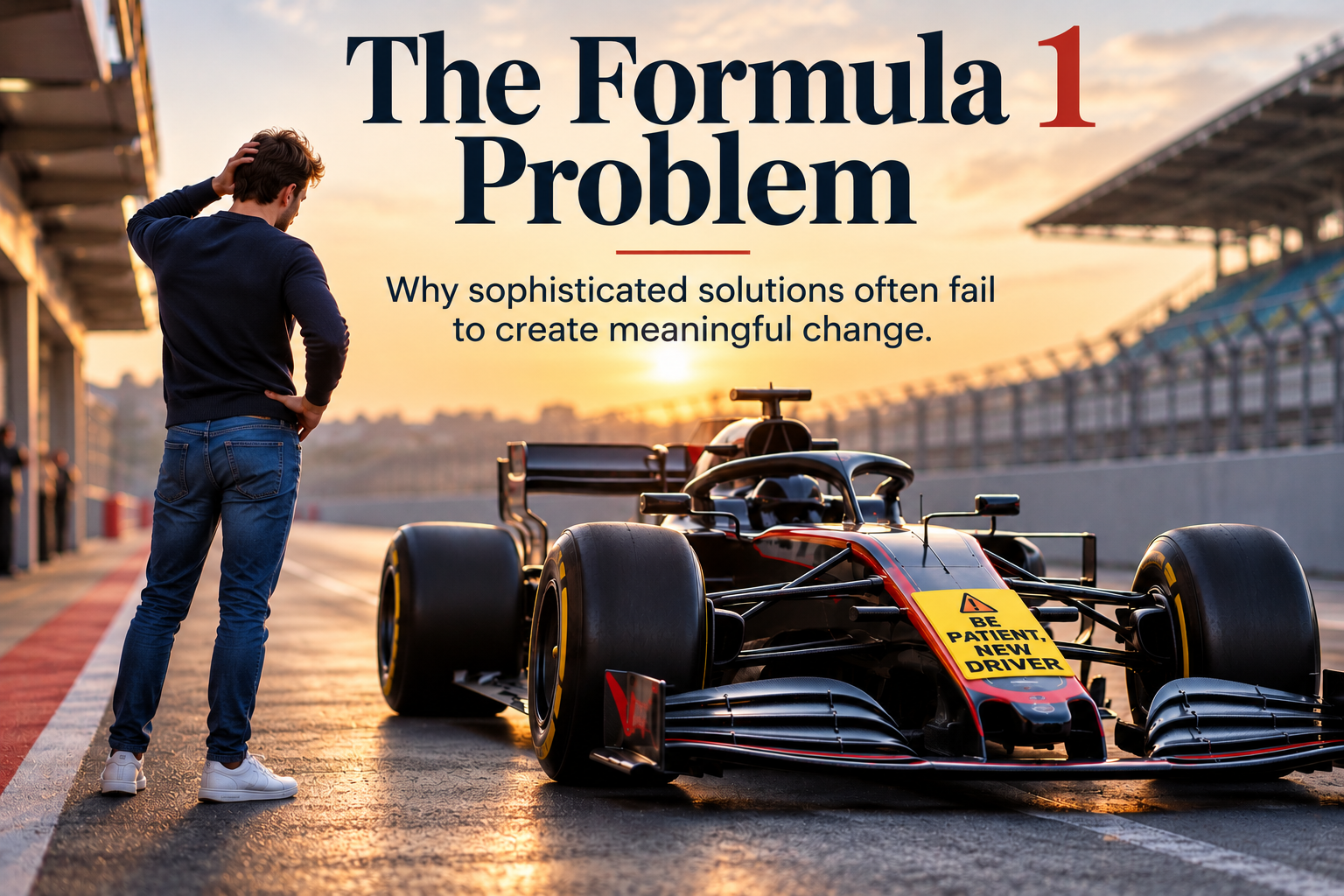
Imagine handing the keys to a $20 million Formula 1 car to someone who has just learned to drive.
The car is extraordinary. The engineering is brilliant. Every component has been designed to deliver exceptional performance.
There's only one problem.
The driver isn't ready.
The best-case outcome? Debris from a $20 million machine scattered across Turn One.
I've seen the business equivalent play out many times.
A company needs to accelerate growth, improve commercial execution, integrate acquisitions, or professionalize its operations. A talented consultant or advisor arrives with sophisticated models, comprehensive frameworks, and a detailed roadmap for transformation.
The recommendations may be entirely correct.
But weeks later, very little has changed.
The advisor wonders why management hasn't executed. Management feels overwhelmed by the complexity of what's been prescribed. Frustration builds on both sides.
And a potentially valuable initiative quietly loses momentum.
The problem isn't the sophistication of the machine. It's the mismatch between the machine and the operator's current capabilities.
The Sophistication Trap
There is a natural tendency in the advisory profession to equate sophistication with value.
Complex analytical models, extensive frameworks, and comprehensive recommendations demonstrate expertise. And in many circumstances, that rigor is absolutely necessary.
But there is also an uncomfortable tension in the traditional consulting business model.
More analysis, more workstreams, more people, and longer engagements generate more revenue. The economics can unintentionally reward complexity, even when a simpler intervention might produce a better outcome.
This isn't an indictment of consultants. Most are genuinely trying to deliver the best possible work.
It's a question of whether we've confused the sophistication of the deliverable with the value of the result.
A similar dynamic can emerge in private equity.
A newly acquired portfolio company may find itself surrounded by operating partners, functional experts, established playbooks, new reporting requirements, and ambitious transformation initiatives, all introduced with the best intentions.
Each intervention may make perfect sense on its own. But collectively, they can overwhelm a management team that is still running the business, adjusting to new ownership, and learning to operate under different expectations.
The question isn't simply whether the sponsor has the right playbook. It's whether anyone has taken the time to understand the organization's capacity to execute it.
A dozen good ideas introduced simultaneously can produce less value than three implemented successfully.
A beautifully designed operating model that nobody implements creates very little value.
Worse, excessive complexity can undermine the very organizational buy-in required to make change happen.
When people don't understand where to begin, how their responsibilities will change, or what success looks like tomorrow morning, they often retreat to familiar ways of working.
What looks like resistance may actually be paralysis.
And the cost extends far beyond the consulting fee. There's the investment that fails to produce results, the momentum that's lost, and the organizational confidence that must be rebuilt before the next initiative can begin.
Meet the Organization Where It Is
Every organization has a finite capacity to absorb change.
That capacity depends on two distinct considerations.
Capability: Does the organization possess the skills, systems, information, and management disciplines required to implement the change?
Capacity: Does it have the time, resources, and organizational bandwidth to do so while continuing to operate the business?
A company may have the capability to execute an initiative but lack the capacity to take it on alongside five others.
Conversely, it may have sufficient bandwidth but lack the underlying capabilities.
A company without reliable customer information isn't ready for an elaborate account management system.
A sales organization that hasn't established basic management routines probably isn't ready for a sophisticated performance architecture.
And a leadership team already stretched by daily operations may struggle to implement five major transformation initiatives simultaneously.
The responsibility of the advisor, or the CEO leading the change, is to understand that starting point.
Not to lower expectations, but to sequence the journey.
Start by identifying the few things that matter most. Make them understandable. Make them actionable. Help the organization execute them consistently.
Then build on the progress.
Simplicity Builds Capacity
Something powerful happens when a team successfully implements a few meaningful changes.
People begin to see results. Confidence grows. Information improves. Managers develop new disciplines. The organization becomes more capable.
And that increased capability makes the next level of sophistication possible.
This is the distinction that often gets lost in transformation programs.
Simplicity isn't the alternative to sophistication. It's often the path to it.
But simplicity is hard.
For experienced operators and advisors, the challenge is rarely a shortage of ideas. It's having the judgment and discipline to decide which ideas matter now, which can wait, and which may never be necessary.
The ability to make something complicated is not the same as the ability to make something simple.
The objective isn't to keep an organization operating with rudimentary processes forever. It's to build the capabilities that allow more sophisticated processes to work.
Sometimes that means introducing simple customer segmentation before a comprehensive commercial operating model.
Sometimes it means establishing three meaningful performance measures before building a dashboard with thirty.
And sometimes it means solving one important problem rather than launching six initiatives that compete for the same limited organizational capacity.
The sophistication belongs in the thinking. The simplicity belongs in the initial execution.
The Real Measure of Advisory Value
Experience should make it possible to distinguish between what is intellectually interesting and what is operationally essential.
That may mean doing substantial analysis. It may also mean recognizing, relatively quickly, that a handful of practical changes will create most of the near-term value.
The measure of a recommendation shouldn't be how impressive it looks in a presentation.
It should be whether the organization understands it, embraces it, and becomes more capable of executing because of it.
This requires something more than knowing what a high-performing organization looks like.
It requires understanding what the organization in front of you is capable of becoming next.
Teach the Driver
There's a reason Formula 1 drivers don't begin their careers in Formula 1 cars.
They typically progress through karting and increasingly sophisticated racing categories as their skills, judgment, and experience develop.
Nobody considers that a compromise in ambition. It's how world-class drivers are developed.
Organizations are no different. Their operating models should evolve alongside their capabilities.
The Formula 1 car may ultimately be exactly what the organization needs. But handing over the keys doesn't make someone a capable driver.
The destination hasn't changed. Neither has the ambition.
Only the path has become more realistic.
Think deeply. Start simply. Build capability.
That's how sophisticated thinking becomes meaningful progress.